
From Performative Protest To Revolutionary Power
Part 1: Protest, Performance, and the Limits of Outrage (Field Notes #002)

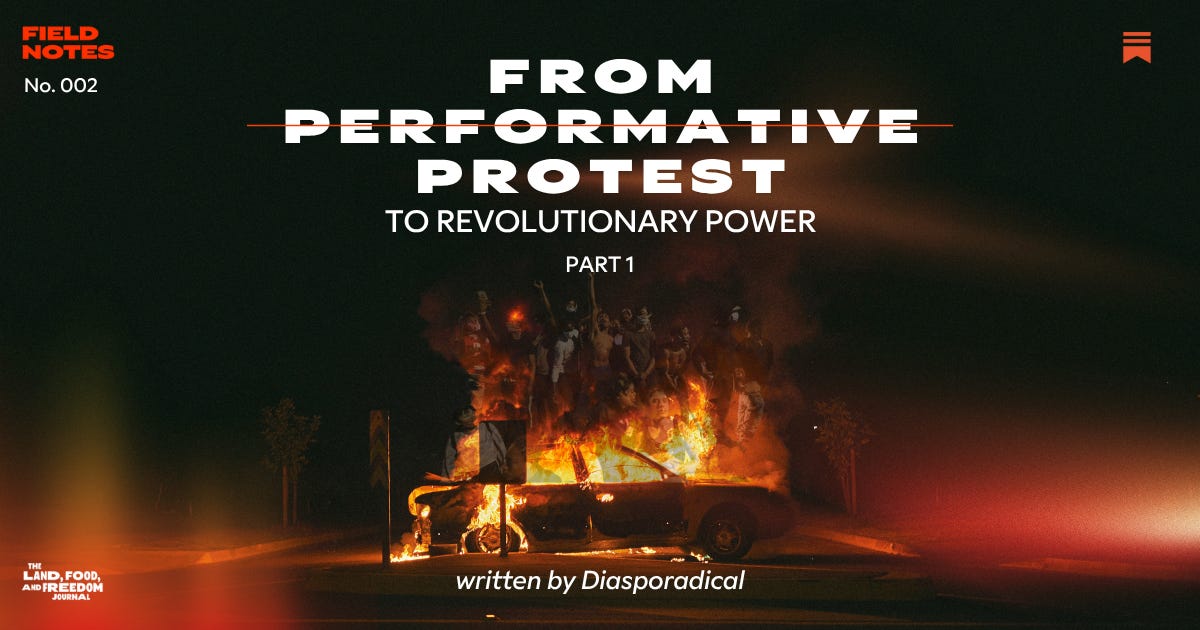
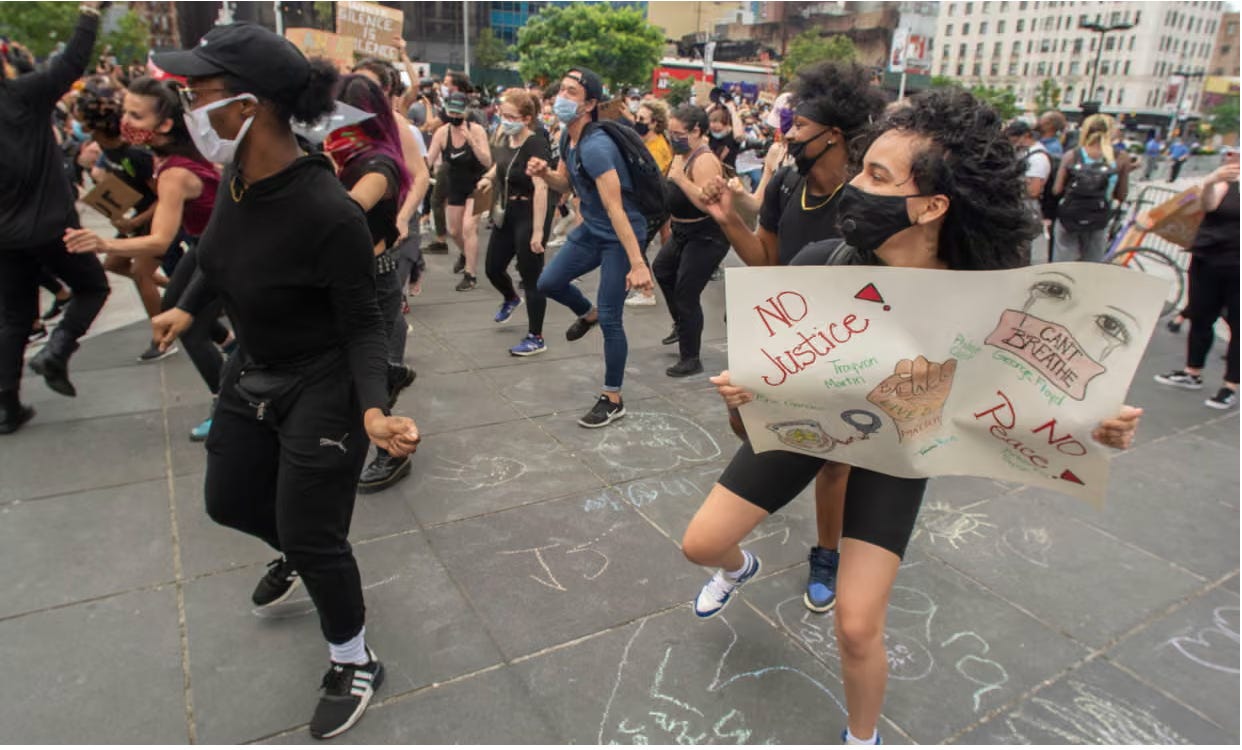
In 2020, millions of people entered the streets with grief, rage, courage, and a demand to abolish the police. But the years since have pushed us to ask harder questions about protest, power, organization, and revolution.
Since then, the terrain has only grown more dangerous and more complex. Raids, surveillance, war, attacks on land and food access, and the use of hunger as a political weapon all remind us that history is not a slew of isolated events. Every moment is connected to what came before it, and every response shapes what becomes possible next.
Before you read any further, we also invite you to read this in community. Read it with friends, comrades, coworkers, students, neighbors and loved ones. Read it out loud if you can. Pause when something challenges you. Let the words open disagreement, memory, reflection, and study. This column is not meant for passive consumption. It is meant to be worked through together.
To study our own actions, slogans, habits, and assumptions is part of acting like scientists. If we do not pause to ask what happened, what worked, what failed, what was absorbed, and what was left behind, we risk repeating the same gestures while the systems we oppose become more coordinated against us.
Field Notes will present Diasporadical’s analysis as an ongoing column designed for group study and discussion among friends, colleagues, comrades, and everything in between. We hope these pieces create space to think together about protest, revolution, organization, cultural work, political education, and the long work of building power.
As you read, hold on to these three questions:
If land, food, and freedom are the horizon, how do we build the capacity to secure any of it for ourselves?
What does political maturity look like under counterinsurgency, co-optation, and spectacle?
What kind of organizational discipline is required to build power that cannot be absorbed, redirected, or pacified?
introduction: remember that time it rained?
imagine a flood. a surge of water so powerful it shakes the foundations of a city. but when it recedes, the streets are just wet, and the city’s planners are already building higher walls. the 2020 uprising was that flood. our grief and rage, a global tide following the murder of george floyd. at its center was a demand that felt, to many, like the ultimate break: abolish the police.
it was a revolutionary horizon made slogan, a moment that seemed to channel the uncompromising fury of malcolm x, who decades earlier had thundered: “stop that compromising sweet-talk. tell them how you really feel. let them know that if they’re not ready to clean their house up, they shouldn’t have a house. it should catch on fire—and burn down.”
but the 2020 protests weren’t that fire. they were the roar of the crowd outside the house—a powerful sound that contained a revolutionary demand, yet remained a performance of appeal aimed at a state that can’t—and won’t—burn itself down.
in the years since, that tide has receded, absorbed by the porous, thirsty ground of commissions, electoralism, and modest budget reallocations. the house didn’t burn; it was merely damp in the lower levels, even as the state began construction on a newer, more fortified wing on higher ground. this jarring disconnect between the scale of the surge and the inertia of the structure forces a bitter reconsideration. it calls to mind nikki giovanni’s stark, revolutionary doubt from her 1968 poem “For Saundra”:
so i thought again
and it occurred to me
maybe i shouldn’t write at all
but clean my gun
and check my kerosene supply
perhaps these are not poetic
times
at all
giovanni’s pivot from writing to preparing—from articulation to action—captures the precise failure of our moment. we’ve been, perhaps, in an age of protest poetry: brilliant in its articulation of rage, beautiful in its collective choruses of “abolish,” yet ultimately insufficient to the material task. we’ve written the poem of the coming storm, but we’ve not built the vessel to navigate it, nor the foundation to survive the flood and build anew on the other side.
this insufficiency is compounded by a persistent, dangerous fantasy: the belief that one faction of the state might save us from another. that the federal department of justice will discipline the brutal local police department. that a liberal city council will defy the conservative state legislature. that the fbi will investigate ice.
this fantasy is a poison, a siren song that leads movements to direct their energy upward, toward appeals to “good” authority, rather than inward, toward building their own power. it’s a fantasy visually and ideologically shattered by the revolutionary art of emory douglas, the minister of culture for the black panther party.
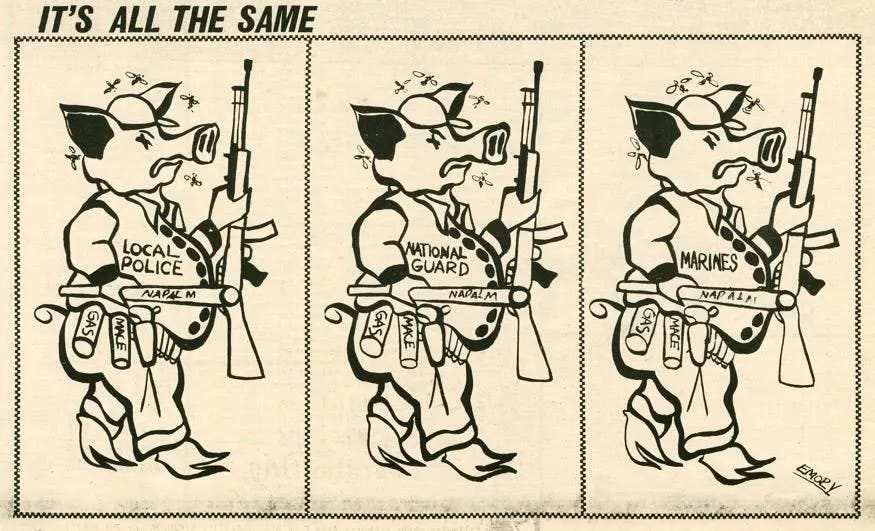
in douglas’ iconic illustrations, the police aren’t depicted as individuals with varying degrees of bias, but as a monolithic, porcine force—”pigs.” their faces are often obscured by helmets or rendered with bestial features, emphasizing their function as an undifferentiated instrument of state repression. the message is unequivocal: there’s no “good” cop in a system designed to patrol and punish the oppressed. the uniform, the badge, the institution itself is the enemy. to appeal to one part of this beast to tame another isn’t just naive; it’s a betrayal of self-determination.
no one is coming to save us.
this clarion call—no one is coming to save us—wasn’t merely an observation but the bedrock of a strategic doctrine for one of the most clandestine and theoretically rigorous revolutionary formations in u.s. history: the revolutionary action movement (ram). active in the 1960s, ram, influenced by robert f. williams, james boggs, and malcolm x, operated from a core principle of revolutionary self-reliance. their analysis argued that black people in america constituted an internal colony, and that the u.s. government wasn’t a potential protector but the “main enemy.” for ram, the state was a singular, antagonistic force. therefore, any strategy based on appeal, reform, or alliance with liberal factions wasn’t merely futile but counter-revolutionary. salvation couldn’t be granted; it had to be seized through the building of independent revolutionary power. ram’s commitment was to the clandestine development of a disciplined, ideologically unified vanguard capable of waging protracted struggle. their perspective casts a harsh, illuminating light on the failures of 2020 and beyond: a movement that doesn’t start from the premise that the state in its totality is the enemy will inevitably waste its energy in dead-end appeals and be outmaneuvered by the state’s unified, adaptive repression.
a consolidated critique of 2020: the spectacle and its aftermath
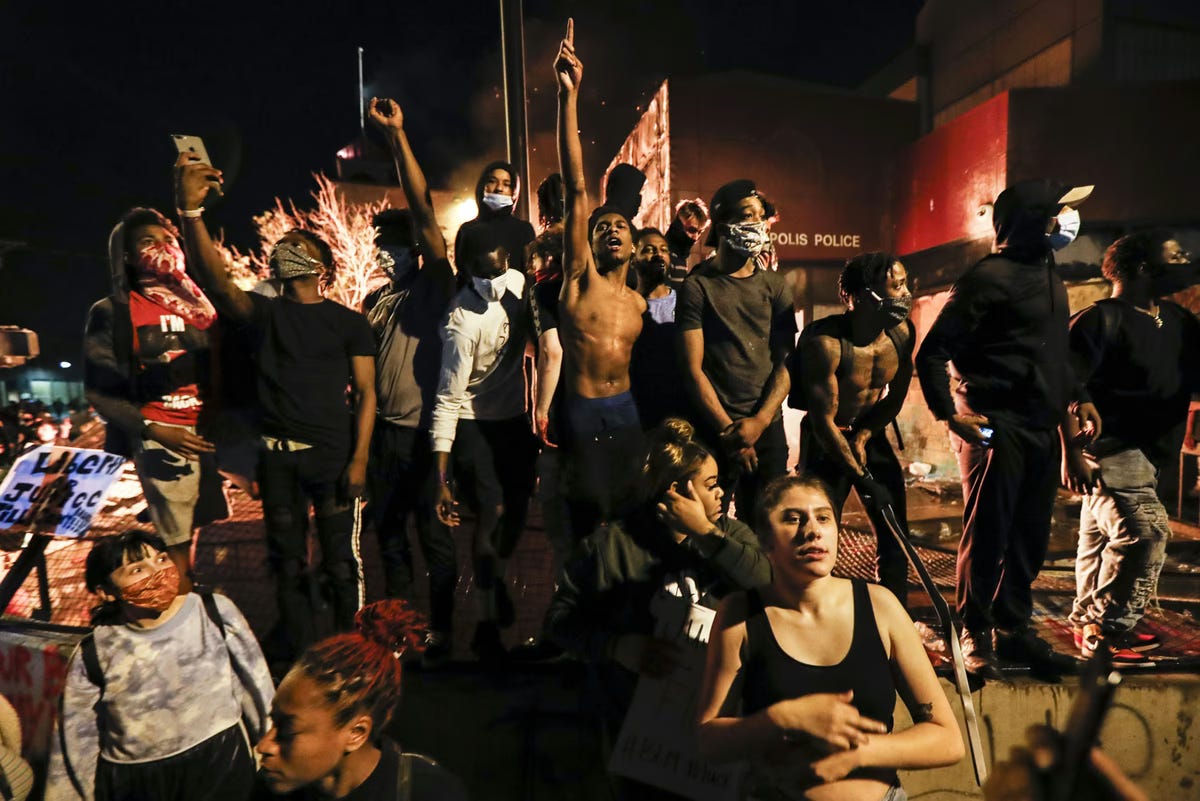
the 2020 uprising was a breathtaking epic poem broadcast on the very surveillance platforms and media monopolies that are pillars of control. its decentralized, digital-native form, while powerful for mobilization, was perfectly designed for capitalist absorption and state monitoring. it failed to dig new channels, to alter the landscape itself. it was a rebellion of feeling, lacking the structure—the canals and the irrigation system—to turn the momentary flood into sustained fertility for a new society. it was a powerful surge that broke on the existing shoreline, easily absorbed, mapped, and framed.
the response to the uprising proved ram’s analysis correct but revealed its modern antagonist: not merely the u.s. government, but the transnational capitalist class for which that state functions as chief manager. this class—a network of oligarchs, shareholders, and c-suite executives of monopolies in tech, finance, pharma, energy, and agribusiness—accumulates wealth through a globalized circuit of exploitation. its police protect its property; its media manufactures consent; its borders enforce a global labor hierarchy. the uprising’s tactical failures were therefore exploited not by a faceless “state,” but by this class’s integrated apparatus. it used surveillance to target organizers. it used media monopolies to reframe “abolish” as “chaos.” it analyzed the decentralized protest model and developed even more decentralized, algorithmic counterinsurgency. the system’s back-and-forth counter-punch to our digital street protest was to double down on what crushes the revolutionary base: more algorithmic rent hikes, more consolidation of agribusiness, more sophisticated propaganda. the transnational capitalist class builds a 21st-century flood-control system while too much of the left relies on the hope of seasonal storms. the house wasn’t burned; it was simply moved to higher, more defensible ground.
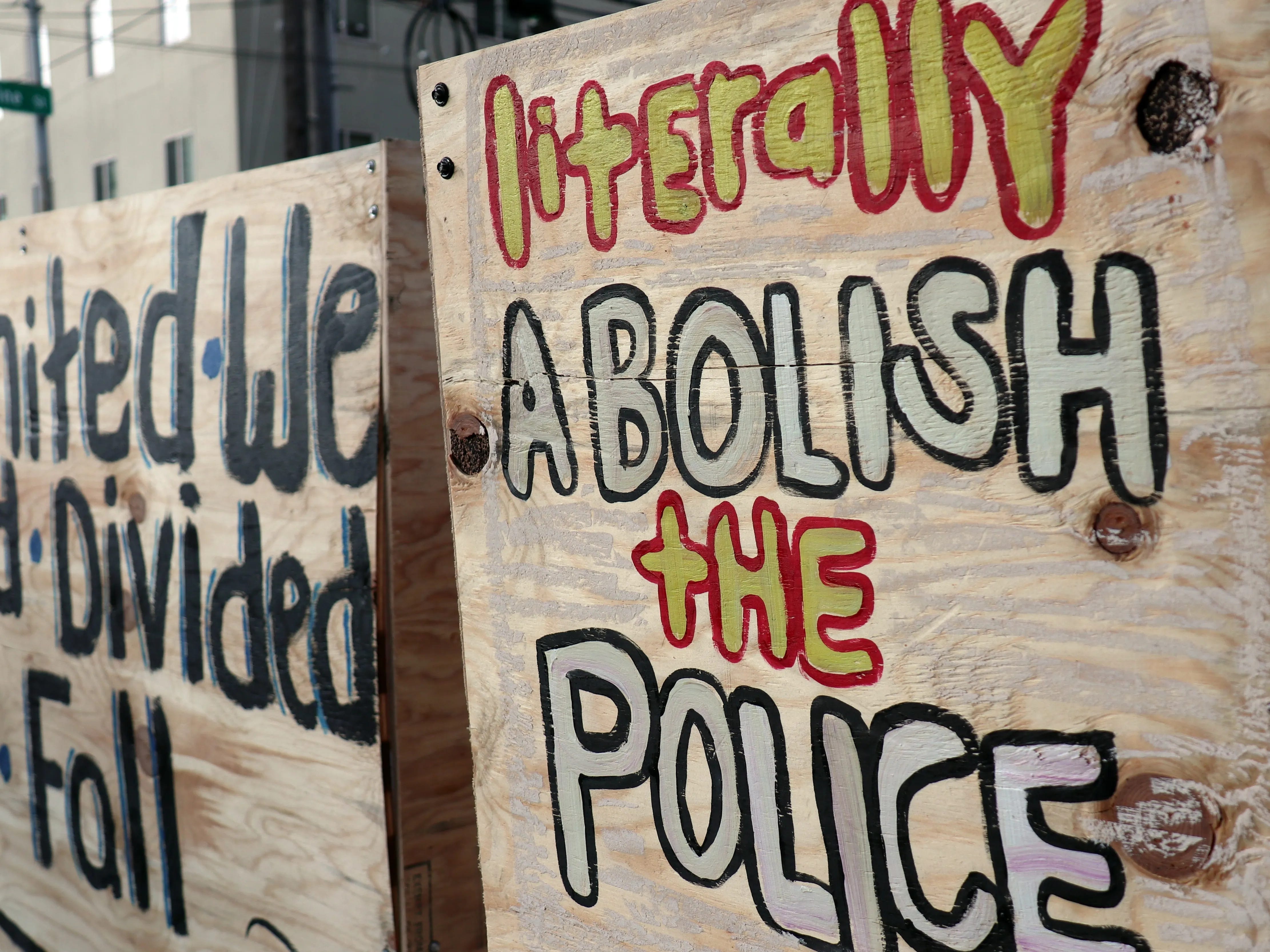
understanding this transforms the critique. the liberal wing of the state isn’t a potential ally, but the soft-management division of this class, specializing in co-opting dissent and administering empire with a multicultural face. this is the essential update to ram’s framework: the enemy is a cross-border capitalist system, with the u.s. state as its most powerful armed enforcer.
the decentralized digital form of mobilization in 2020 wasn’t merely a tactical choice; it was the manifestation of a deeper ideological surrender, a triple fetish that plagues modern movements: the fetish of the leaderless, the fetish of the horizontal, and the fetish of the anti-intellectual. together, these fetishes create the perfect activist for the empire: a leaderless, meeting-obsessed crowd that distrusts its own history—easy to monitor, easy to divide, impossible to sustain. these aren’t radical critiques of power; they are the internalized logic of a system built on alienation, disorganization, and the severing of theory from practice. they are the conditions for a movement perfectly designed to be monitored, manipulated, and metabolized.
the clearest articulation of this poison is found in jo freeman’s 1970 essay, “the tyranny of structurelessness.” freeman exposes the lie that rejecting formal structure creates equality. instead, it masks the emergence of an informal, unaccountable elite—with the most social capital, time, rhetorical skill, and the leisure time to dominate discussions —who wield power without responsibility. this is the hidden architecture of the leaderless protest. when we fetishize “no leaders,” we don’t abolish power; we merely render it invisible and unaccountable and often led by those least connected to the material base. the media anoints its own spokespeople. the most charismatic white anarchist becomes the de facto strategist. the informal networks that decide actions are closed to those without the right cultural cues. this structurelessness is a gift to the state: there’s no head to cut off, but also no body to negotiate with, no disciplined force capable of strategy. it’s a crowd, not an army. it allows the most privileged participants to perform radicalism while the exploited masses—those who actually need durable organizations to win material victories—are left without a vehicle.
this fetish seamlessly binds to the fetish of horizontalism, which mistakes a moral sentiment for a strategic method. horizontality as a substitute for organization is suicidal. it produces endless process, paralysis of the lowest common denominator, and an allergic reaction to the division of labor, delegated authority, and sustained commitment required to build anything that lasts. it mirrors the very alienation of late capitalism—a flat network of isolated individuals—while believing it’s its opposite. this fetish ensures that movements can’t build long-term institutions, because building requires division of labor, delegated authority, and sustained commitment—all branded as “hierarchical.” it ensures the movement rises and falls with the emotional tide of the protest, leaving behind no permanent base-building institution. the tenant union, the workers’ council, the dual-power project—these require structure. they require saying “we’ll be here tomorrow.” the horizontalist fetish prefers the pure, spontaneous explosion to the gritty, long-term work of building power among those who can’t afford spontaneity.
this aversion to structure is fed by a fetish of anti-intellectualism, a proud mistrust of theory and political education. it confuses jargon for theory and theory for inaction. but as ram understood, a movement without a shared revolutionary analysis is a mob—directionless and easily herded. this anti-intellectualism severs us from our own history and from the analyses of cabral, boggs, or williams. it reduces ideology to slogans, empty signifiers to be chanted but not comprehended. this is how “abolish the police” can be screamed by those who will later call 911. disconnected from the material analysis of the state as a unified enemy, the slogan becomes a posture, not a program.
and co-optation is the inevitable result. the ruling class, particularly through its liberal wing in the democratic party, are master chemists of this formless rage. their most potent instrument of control is the promise of black capitalism: the elevation of individual black faces into the circuits of finance and corporate power as a supposed victory for “the community,” while the material base of that community—its working-class and poor majority—is further stripped of housing, health, and stability. the global ruling class observes the leaderless, horizontal, anti-intellectual movement and sees not a threat, but a resource. they identify the most palatable, media-anointed leaders and offer them the bribe of inclusion: seats on city commissions, funded organizations that monitor poverty instead of ending it, partnerships with predatory banks. the demand to “abolish the police” is metabolized into a call for more black police chiefs and more funding for “community policing” initiatives that expand surveillance. the democratic party becomes a movement graveyard, not only by hiring rebels as gravediggers, but by creating a managerial class of professional gravediggers from the very communities in revolt.
the circuit is complete. the performative protest, born of these three fetishes attracts a participant who is often a spectator to their own rebellion— whose commitment expires with the trend cycle, who doesn’t represent the daily, grinding material terror of the poor black and brown working class. the base doesn’t need another hashtag; it needs a stopped eviction, a food source, a defense against police terror. it needs an organization that outlives a news cycle and can deliver those wins, articulating them as fragments of a larger struggle. and the protest can’t provide what’s needed. it’s a firework: spectacular, loud, and then gone, leaving only smoke for the state to trace.
today’s movements against ice and cbp echo the poetry of 2020 and are subject to the same terrain. to declare the new wing should burn while organizing on platforms owned by our adversaries and failing to address mass despair that prevents sustained commitment, is to guarantee failure. the revolutionary synthesis must be a set of tactics updated for the siege that we’re under.
so if ram gave us the unflinching analysis of the enemy, and the triple fetish shows the sickness in our own movements, we face the most urgent question: how do we break the cycle? not with another, bigger rebellion destined to be absorbed, but with something that can actually win. this requires a theory not just of saying ‘no,’ but of building ‘yes.’ this is the bridge provided by james and grace lee boggs.
Part 1 ends here, but coming May 26, Diasporadical moves from critique toward construction. What comes after the flood? What does it mean to build revolutionary power beyond the spectacle of protest? And how do we move from shared outrage toward disciplined organization, material struggle, and the creation of territory that can actually sustain us? Subscribe to stay in the loop!
Glossary
Electoralism: the belief that elections are the main or most important way to create political change. In movement spaces, the term is often used critically to describe strategies that focus too heavily on voting, candidates, campaigns, or policy reform while neglecting organizing, political education, direct action, and building power outside the state.
Porcine: pig-like or related to pigs. In political writing, it is sometimes used as a sharper or more literary way to refer to police, especially because “pig” has long been used as a slang term for police officers.
Protracted: extended over a long period of time. A protracted struggle is not quick or immediate. It requires patience, discipline, study, organization, and endurance.
Antagonist: a force, person, group, or system that stands in opposition to another. In political analysis, the antagonist is not simply a “bad guy.” It is the force whose interests directly conflict with the interests of the people or movement.
Transnational Capitalist Class: wealthy and powerful people, corporations, investors, and institutions whose economic interests stretch across national borders. They are not loyal to one country in a simple way. Their loyalty is to profit, investment, markets, and control.
Oligarchs: extremely wealthy and powerful people who have major influence over politics, the economy, and society. An oligarchy is a system where a small group of elites holds power, even if the country claims to be democratic.
Manufacture Consent: comes from the idea of manufacturing consent, meaning that governments, corporations, media outlets, schools, and other institutions shape public opinion so people accept certain policies, wars, economic systems, or forms of oppression as normal or necessary.
Fetish: when people give an object, symbol, action, or idea more power than it actually has, while ignoring the real social relationships behind it. For example, if people treat protest itself as automatically revolutionary, without asking whether it builds power, organization, or strategy, protest can become a fetish.